| Profile Summary | Details |
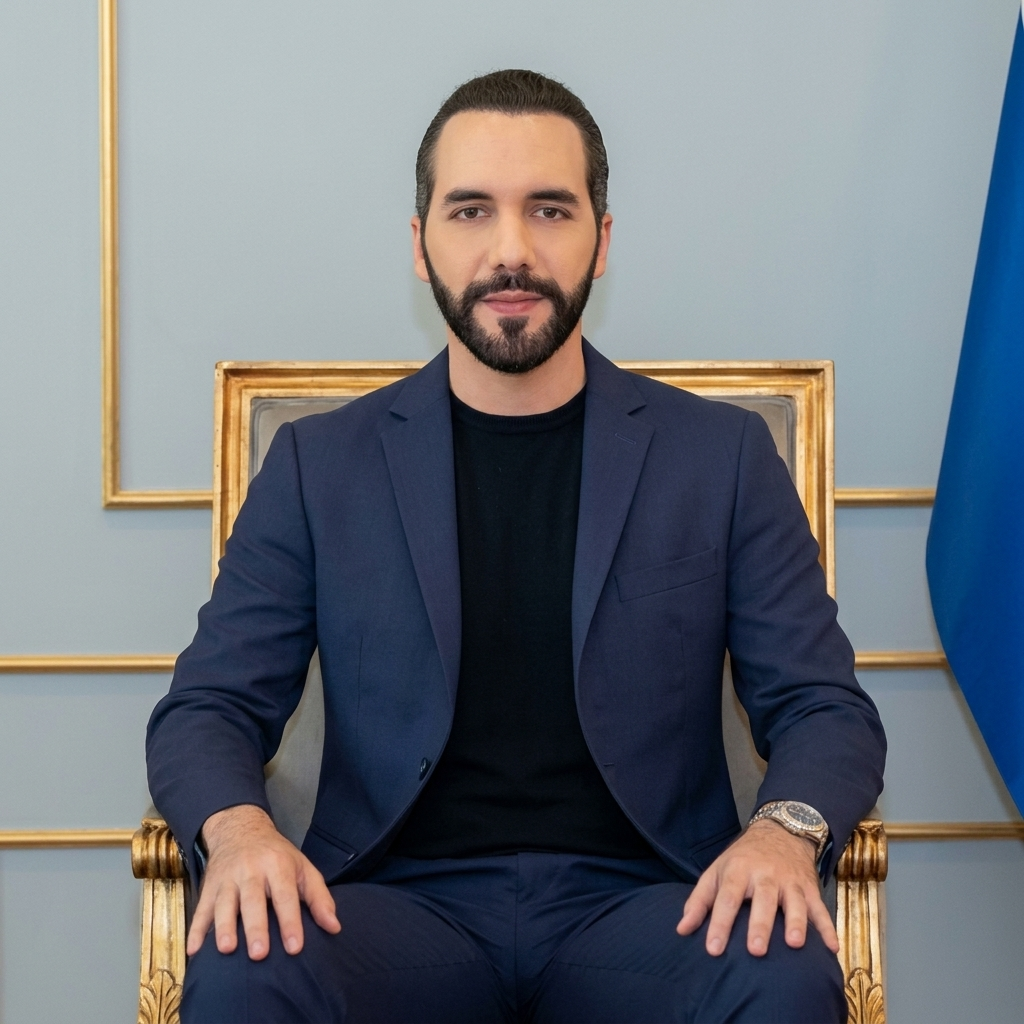
| Name | Nayib Bukele |
| Education | Law at Universidad Centroamericana (Dropped Out) |
| Profession | Politician |
| Key Contribution | Sovereign Bitcoin Adoption |
| Known For | Bitcoin Legal Tender |
Origin & Background
Nayib Bukele was born on July 24, 1981, in San Salvador, El Salvador [1]. His father, Armando Bukele Kattán, was a highly influential businessman, organic chemist, and imam of Palestinian descent who built deep ties across El Salvador’s commercial landscape [1, 2]. Bukele briefly studied law at the Universidad Centroamericana (UCA) but chose to leave his degree unfinished to immerse himself in his family’s business operations, primarily focusing on marketing, advertising, and public relations [2].
This early immersion in entrepreneurship allowed Bukele to manage several successful businesses before transitioning into public service. He earned a reputation as a master communicator. He utilizing social media with an efficacy never before seen in Central American politics [3]. His sharp marketing instincts and youthful, forward-facing presentation instantly distinguished him from traditional Salvadoran political figures.
El Salvador’s severe economic limitations deeply shaped Bukele’s outlook. For decades, approximately 70% of Salvadorans lacked access to traditional bank accounts. A vast majority of the population was entirely excluded from the formal financial system [4]. Cross-border remittances sent home by Salvadorans living abroad constituted over 20% of the nation’s Gross Domestic Product (GDP) [4, 5]. This reliance on international wire transfer services subjected working-class families to predatory transaction fees. Bukele recognized that these structural flaws created the perfect conditions for a parallel financial system to take root.
In 2014, he married Gabriela Rodríguez, an educator and prenatal psychologist who became his closest adviser and political partner [1]. Together, they projected an image of youthful, modern Salvadoran leadership that challenged the old guard of the nation’s political establishment.
Pre-Bitcoin Career
Bukele entered public office in 2012 after winning the mayoral race in the municipality of Nuevo Cuscatlán from Farabundo Martí National Liberation Front (FMLN) party [2]. He quickly turned the small municipality into a model town with his infrastructure development policies youth programs, and healthcare initiatives. [2, 3].
In 2015 Bukele ran for and won the mayoralty of San Salvador, the nation’s capital [1]. As mayor of El Salvador’s most important metropolis, he led the revitalization of the historic downtown district, modernized city services, and expanded public safety measures. He leveraged social media to directly speak to citizens to build a fiercely loyal, nationwide youth demographic [3].
His independent yet fearless style that criticized systemic corruption inevitably clashed with party leadership, which led to his formal ouster from the FMLN in 2017 [2]. In response, Bukele founded his own political movement, Nuevas Ideas (New Ideas). His party quickly grew into the most dominant political force in modern Salvadoran history [3].
Positioning himself as a populist outsider determined to break the ‘corrupt’ and decades-long duopoly of the right-wing ARENA and left-wing FMLN parties, Bukele launched his presidential campaign. Traditional politicians consistently underestimated his digital-first appeal. In February 2019, Bukele won the presidency in a historic landslide with 53% of the total vote in the first round [6].
The Bitcoin Awakening
Bukele’s interest in Bitcoin was born from a pragmatic search for economic sovereignty. El Salvador received roughly $6 billion in remittances annually, with a massive portion of that capital being siphoned away by financial intermediaries like Western Union and MoneyGram [4, 5]. He realized that Bitcoin’s underlying technology, specifically the Lightning Network, offered a global payment system that required no traditional banking infrastructure and could return millions of dollars directly to Salvadoran households.
Around 2019 and 2020, Bukele began studying the economic implications of the digital asset. He took note of the grassroots Bitcoin circular economy developing in El Zonte, a coastal Salvadoran village known as “Bitcoin Beach” [7]. Witnessing unbanked local merchants and families use the Lightning Network for daily transactions convinced him that Bitcoin was not merely a speculative vehicle, but a viable financial tool for the masses.
To scale this model nationally, Bukele consulted extensively with Jack Mallers, the founder of the Bitcoin payment app Strike [8]. Mallers demonstrated how digital payments could settle instantly and for fractions of a penny across borders. This operational efficiency, combined with Bitcoin’s fixed supply and censorship-resistant nature, aligned perfectly with Bukele’s desire to reduce El Salvador’s absolute dependence on the US dollar. Moving with characteristic speed, Bukele drafted a plan to transition the nation into the world’s first sovereign Bitcoin economy.
Evolution of the Bitcoin Nation
At the Bitcoin 2021 conference in Miami, Bukele through a pre recorded message announced that El Salvador would adopt Bitcoin as legal tender [8]. Days later, in June 2021, he submitted the “Bitcoin Law” to the Legislative Assembly, where it was approved by a supermajority within hours [9]. The law officially took effect on September 7, 2021, establishing El Salvador as the first country to put Bitcoin on equal footing with its national currency [9].
To facilitate adoption, the government launched the state-backed Chivo Wallet and credited every citizen who registered with $30 worth of Bitcoin [4]. Over three million Salvadorans downloaded the app within its first month of release. To back this digital infrastructure, the government installed over 200 fee-free Chivo ATMs nationwide, allowing citizens to seamlessly convert digital Bitcoin into physical cash dollars [4, 9].
In tandem with local adoption, Bukele began utilizing public funds to purchase Bitcoin directly for El Salvador’s national treasury [10]. By mid-2026, El Salvador’s cold-storage sovereign treasury grew to hold more than 5,800 BTC, representing a highly publicized and transparent digital reserve fund [10].
This monetary shift triggered fierce resistance from global financial organizations. The International Monetary Fund (IMF) and the World Bank repeatedly pressured Bukele to repeal the Bitcoin Law, warning of financial instability and debt defaults [11]. Bukele steadfastly refused, framing their opposition as an imperialistic attack on his nation’s self-determination. Over time, Bukele adjusted regulatory guidelines to emphasize voluntary commercial adoption, easing international concerns while preserving Bitcoin’s status as a legal, tax-exempt monetary asset [11].
Bitcoin Specific Inititatives
To further cement El Salvador’s status as a global digital asset hub, Bukele introduced two ambitious initiatives:
- Bitcoin City: Announced in November 2021, this planned tax-free metropolis near the Conchagua volcano is designed to run entirely on geothermal energy, powering both the city and massive state-run Bitcoin mining operations [12].
- Volcano Bonds: In December 2023, El Salvador’s National Bitcoin Office officially approved these tokenized bonds to raise $1 billion in capital, split evenly between direct Bitcoin purchases and funding geothermal mining infrastructure [13].
Bukele’s bold strategies culminated in a resounding political victory. In February 2024, he won reelection with an unprecedented 85% of the popular vote, cementing a mandate to continue his economic and security reforms [14].
Philosophy & Ideology
Bukele’s Bitcoin philosophy is rooted in geopolitical pragmatism rather than pure libertarian idealism. While many Bitcoin developers focus on anti-government philosophy, Bukele views Bitcoin as a powerful instrument of state sovereignty. For a small country that surrendered its monetary policy when it dollarized in 2001, Bitcoin represents a path toward monetary self-defense, offering protection against the inflationary policies of foreign central banks.
He views financial inclusion as an urgent humanitarian issue. To Bukele, locking the unbanked out of the economy is a form of systemic oppression. By providing a free, open monetary network accessible via any basic smartphone, his policies bypassed the costly paperwork and institutional barriers of legacy banking.
His approach to governance is unapologetically disruptive. He routinely dismisses the warnings of academic economists and international bodies as outdated dogmas designed to keep developing nations subservient. For Bukele, El Salvador’s experiment is a blueprint for other small nations seeking to break free from traditional debt cycle.
“Bitcoin is not just a currency. It is a tool for economic liberation for countries like El Salvador, allowing us to build our own future without relying on the permission of global financial elites.” — Nayib Bukele [12]
The Record
Key Contributions
- Bitcoin Law passage making Bitcoin legal tender — June 2021
- Chivo Wallet launch providing $30 Bitcoin to every citizen — September 2021
- National Bitcoin reserve accumulation at 7712 Bitcoin currently
- 210 to 215 Bitcoin ATMs are installed countrywide
- Bitcoin City announcement — November 2021
- Volcano Bonds of approximated $1 Billion were successfully issued
- Geothermal Bitcoin mining: This setup allocates 1.5 Megawatts to run 300 specialized mining rigs. So far over 474 Bitcoin mined till date.
- IMF loan of $1.4 Billion secured that made Bitcoin acceptance as voluntary for businesses. The deal phased out national tax payment with Bitcoins and pushed Chivo wallet out from Public sector control
References & Footnotes
- Presidencia de la República de El Salvador (Official Biography)
- https://www.presidencia.gob.sv/presidente-de-la-republica/ — The official executive portal displaying the President’s certified biography, life history, and family background.
- Universidad Centroamericana José Simeón Cañas (Academic Portal)
- https://www.uca.edu.sv/ — The official university website housing directories and regional academic archives.
- Nuevas Ideas Party Registry
- https://nuevasideas.com/nosotros — The “About Us” page detailing the founding, values, and rise of the political movement established by Bukele.
- Central Reserve Bank of El Salvador (Financial Inclusion & Remittance Data)
- https://www.bcr.gob.sv/esp/index.php?option=com_k2&view=item&id=1506 — The specific central bank portal providing data on remittance receipts, banking penetration, and financial statistics.
- World Bank Migration and Remittances Database
- https://www.worldbank.org/en/topic/migrationremittancesdiasporaissues — The exact landing page for the World Bank’s global migration and remittance metrics.
- Supreme Electoral Tribunal of El Salvador (TSE Election Records)
- https://www.tse.gob.sv/documentos/ — The official document repository containing verified, certified voting statistics for Salvadoran elections.
- Bitcoin Beach Project Portal (El Zonte)
- https://www.bitcoinbeach.com/ — The official portal detailing the grassroots circular economy experiment in El Zonte.
- Strike Official Announcement (El Salvador Integration)
- https://strike.me/blog/announcing-strike-el-salvador/ — The exact corporate press release from Strike detailing the 2021 rollout and integration with El Salvador’s infrastructure.
- Official Legislative Gazette (The Bitcoin Law Decree No. 57)
- https://www.diariooficial.gob.sv/diarios/2021/06-Junio/09-06-2021.pdf — The exact PDF of the June 9, 2021, Diario Oficial containing the fully codified, legally binding “Ley Bitcoin.”
- Sovereign Treasury Tracker (Nayib Tracker)
- https://nayibtracker.com/ — The real-time, public portfolio tracker monitoring El Salvador’s sovereign Bitcoin purchases based on Bukele’s public disclosures.
- International Monetary Fund (IMF Article IV Consultations)
- https://www.imf.org/en/Countries/SLV — The country-specific IMF hub containing staff reports, financial risk warnings, and statement archives regarding El Salvador’s economy.
- National Bitcoin Office of El Salvador (ONBTC Official Site)
- https://www.onbtc.gob.sv/ — The official homepage of the state administrative office managing El Salvador’s sovereign Bitcoin initiatives, volcanic mining projects, and Volcano Bonds.