
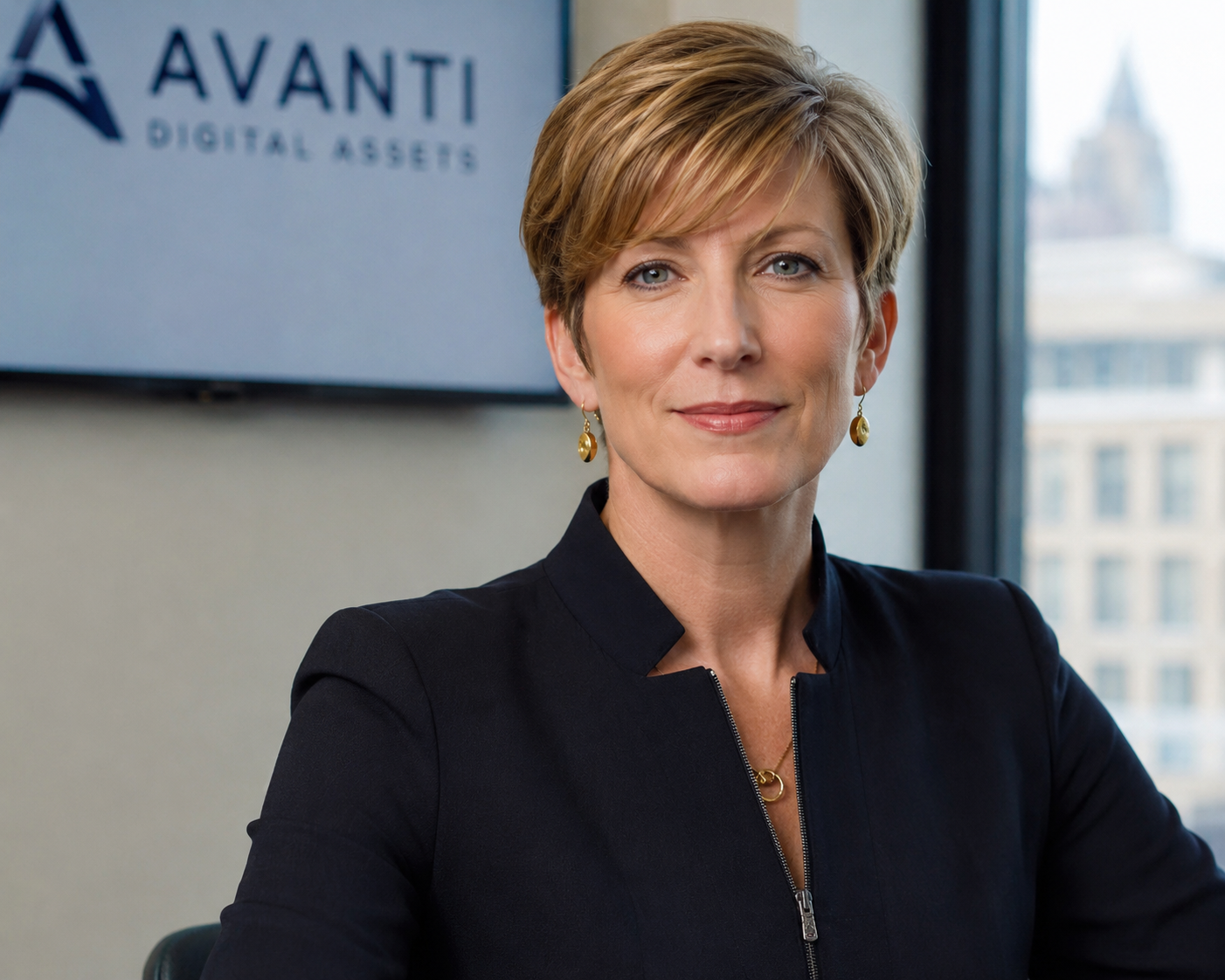
Origin & Background
To understand why Caitlin Long chose Bitcoin with the ferocity she did, you have to understand where she came from — and what it cost her to walk away from it.
Caitlin Long grew up in Laramie, Wyoming—a place far removed from the tech and finance worlds of Silicon Valley or Wall Street. Ironically, she later helped turn her home state into a leader for Bitcoin-friendly laws. Wyoming is known for ranching and energy. It is a place where self-reliance was not a philosophy but a practical necessity and where the relationship between individuals and institutions was defined by deep instinct for independence that ran through the culture like a geological seam.
That instinct shaped Long before she could articulate it. Growing up in Wyoming gave her a understanding of what financial self-sufficiency meant — and what its absence cost. Rural communities in states like Wyoming have historically been underserved by the same banking infrastructure that cities take for granted. The friction, the exclusion, the condescension of financial institutions toward people and places that did not fit their preferred customer profile were not abstract concepts. They were part of the landscape.
Her academic brilliance took her far from Wyoming’s open spaces. She attended Harvard University where she earned a Juris Doctor and a Masters n Public place. It’s at Harvard she the intellectual rigor and interdisciplinary range that would later allow her to operate simultaneously as a financier, a lawyer, a legislator, and a Bitcoin advocate without losing coherence in any of those roles.¹ Her legal education proved invaluable decades later when she found herself drafting legislation and arguing against the Federal Reserve in federal court.
Pre-Bitcoin Career
For twenty-two years, Caitlin Long was Wall Street.
She built her career at some of the most prestigious financial institutions in the world — Morgan Stanley and Credit Suisse — rising through the ranks of an industry that rewards a specific combination of analytical brilliance, political sophistication, and the ability to operate comfortably within systems whose internal contradictions you have learned not to examine too closely.²
Long examined everything herself. Her refusal to accept the status quo and her drive to understand the “actual mechanics” of finance made her exceptionally good at her job. Ultimately, these same traits made her one of Wall Street’s most articulate critics.
Her specialization was in the intersection of financial markets, technology, and institutional structure, the places where the plumbing of the financial system was most visible and most complex.² She worked on projects involving securities settlement, financial infrastructure, and the mechanics of how capital actually moved through the system at an institutional level. This was not glamorous work in the way that trading or investment banking was glamorous. It was the unglamorous work of understanding how the machine actually functioned and this turned out to be the most valuable education possible for someone who would later spend years arguing that the machine was fundamentally broken.
What she learned during those twenty-two years was both impressive and deeply unsettling. The global financial system, viewed from the inside, was a vastly more fragile, more opaque, and more structurally dishonest construction than its public presentation suggested. Settlement systems that appeared to operate in real time actually involved layers of counterparty risk and delayed finality that most participants — including many professionals — did not fully understand. The relationship between what people believed they owned and what they actually owned, in a legal and technical sense, was mediated by layers of institutional custody and rehypothecation that created systemic vulnerabilities of enormous scale. ²
The 2008 financial crisis confirmed everything she had privately suspected. The system did not merely experience a shock from outside. It showed deep, long-standing flaws: hidden risks, excessive borrowing, and a system that put its own profits ahead of its customers and the economy. Long watched the crisis unfold with the particular clarity of someone who had spent two decades learning exactly how the machine worked and could therefore see precisely which gears were failing and why.
She continued her Wall Street career after 2008, but the crisis had done something irreversible to her relationship with the system. She was still inside it. She still understood it better than most. But she no longer believed in it — not as a structure deserving of loyalty, not as an architecture worthy of permanent commitment. She was, without yet knowing it, looking for something better.
She found it in 2012.
The Awakening
Caitlin Long’s Bitcoin awakening arrived around 2012 and it arrived not as a revelation about money but as a recognition about settlement.
Where most early Bitcoin adopters encountered the protocol through its monetary properties — the fixed supply, the censorship resistance, the permissionless access — Long encountered it through the lens of financial infrastructure that twenty-two years on Wall Street had given her.¹ She read about Bitcoin’s blockchain and understood immediately something that most observers missed entirely: Bitcoin settled transactions with true finality.
This sounds technical. Its implications are profound.
In the traditional financial system, settlement, the actual transfer of ownership from one party to another is a process that takes days, involves multiple intermediaries, and carries counterparty risk at every step. What appears to be an instantaneous transaction is actually the beginning of a settlement process that may not complete for two or three business days, during which time the transaction can theoretically fail, be reversed, or be complicated by the insolvency of an intermediary. The entire architecture of Wall Street risk management exists, in significant part, to manage the counterparty risk created by this settlement gap.
Bitcoin eliminated the settlement gap. A confirmed Bitcoin transaction was final. There was no counterparty. There was no intermediary who could fail. There was no rehypothecation, no fractional reserve, no gap between what you believed you owned and what you actually owned. The blockchain was the settlement system — and it settled with a finality that no traditional financial infrastructure could match.³
For Long, this was not merely interesting. It was an indictment. She had spent two decades operating inside a system that obscured its own structural fragility through layers of institutional complexity. Bitcoin’s architecture made that fragility visible by contrast — and made its solution legible for the first time.
“Bitcoin is the first asset in history where you can have absolute certainty about who owns what. That is not a small thing. That is everything.” — Caitlin Long [VERIFY: exact quote and source]
She did not immediately walk away from Wall Street. The conviction built over years, deepening as she studied Bitcoin’s technical architecture more carefully and as the implications of its settlement model became clearer to her. But from 2012 onward, her trajectory was set. The question was not whether she would leave the traditional financial system. It was what she would build when she did.
The answer turned out to be a bank. But not any bank — a bank designed from first principles around Bitcoin’s model of full reserve, final settlement, and genuine custody. A bank that would demonstrate, by existing, that honest banking was possible.
First, she had to build the legal infrastructure to make it legal.
Evolution
Caitlin Long evolved from a Wall Street veteran into a powerful advocate for Bitcoin through a series of pivotal shifts. Throughout this journey, she remained convinced that the traditional financial system is fundamentally flawed, and that Bitcoin is the first true alternative.
Caitlin Long’s first big move in the Bitcoin world wasn’t launching a business, but transforming an entire state. In 2018, she returned to Wyoming and help lawmakers build a clear, legal foundation for blockchain companies. This was tough, behind-the-scenes work that involved simplifying complex tech for politicians, building bipartisan support, and pushing through the slow grind of the legislative process.
Long’s advocacy for Bitcoin was remarkably successfully. Wyoming passed a series of landmark laws that collectively created the most Bitcoin-friendly regulatory environment in the United States.⁴ The legislation covered a wide range of issues, including how digital assets would be legally recognized and how specialized depository institutions could operate. It also introduced a new type of banking charter tailored for cryptocurrency firms seeking clear regulatory approval and full compliance within the financial system.
The Wyoming legislation was not merely locally significant. It became a model that other states studied and, in some cases, emulated. Long had demonstrated that it was possible to create sensible, workable regulation for Bitcoin — that the choice was not between the Wild West and the existing banking system’s regulatory framework but between thoughtful innovation and regulatory stagnation.
In 2020, Long founded Custodia Bank — originally called Avanti Bank — as the practical embodiment of everything she had been arguing for years.⁵ Custodia was designed as a full reserve bank: every dollar deposited would be held as a dollar in reserve, with no fractional reserve lending, no rehypothecation, no counterparty risk. It would hold Bitcoin on behalf of institutional clients with the same full reserve model — genuine custody, genuine finality, genuine ownership.
The business model was deliberately conservative and principled. Long was not trying to maximize returns through leverage. Caitlin Long wanted to prove that a bank could be both honest and profitable—a place that actually keeps the assets it claims to have. To do this, her company, Custodia, applied for a “master account” at the Federal Reserve. This account is essentially the Golden Ticket for any bank; without it, you can’t plug into the U.S. payment system or operate on your own.⁵
What followed was one of the most consequential regulatory battles in Bitcoin’s institutional history.
The Federal Reserve denied Custodia’s master account application in January 2023 — after more than two years of review.⁵ The denial was unprecedented. In its specifics, the Fed cited concerns about Custodia’s Bitcoin business model in terms that Long and her legal team argued went far beyond the Fed’s statutory mandate. Custodia sued the Federal Reserve, initiating a prolonged legal battle against Federal Reserve. Recently the case went in the favor of defendant.
The denial landed in a context that made its significance impossible to ignore. Operation Chokepoint 2.0 — the informal name given to what Long and other Bitcoin advocates described as a coordinated effort by federal regulators to pressure banks into cutting off relationships with Bitcoin and cryptocurrency businesses — was becoming increasingly visible through 2022 and 2023.⁶ Banks that had previously served Bitcoin companies were quietly terminating relationships. New accounts were being denied. The banking system’s access points for legitimate Bitcoin businesses were narrowing in ways that appeared systematic rather than coincidental.
Long became one of the most prominent and technically credible voices documenting and challenging this pattern. Her Wall Street background gave her the institutional knowledge to understand what was happening at a structural level. Her legal training gave her the language to articulate it precisely. And her founding of Custodia, a legitimate, well-capitalized, carefully regulated institution that was nevertheless being denied basic banking access, gave her a concrete case study that was difficult to dismiss as paranoia or special pleading.
Through her congressional testimony, public articles, and constant presence in Bitcoin media, she became the most effective voice for a case the crypto community felt deeply but struggled to express with professional weight. She argued that the American regulatory system was being used to unfairly target Bitcoin companies. This systematic disadvantage allegedly served existing financial giants and went well beyond the actual legal power granted to regulators.
“This is not about consumer protection. This is about protecting the existing financial system from competition it cannot survive on a level playing field.” — Caitlin Long [VERIFY: exact quote and source]
Through all of it — the legislative victories in Wyoming, the founding of Custodia, the Federal Reserve battle, the Operation Chokepoint advocacy — Long maintained a consistency of purpose and a clarity of argument that made her one of the most effective institutional advocates Bitcoin has ever had. She was not performing conviction. She was living it at significant personal and professional cost and against opponents with vastly more institutional power, in service of a principle she had held since 2012: that honest money deserved an honest banking system.
Philosophy & Ideology
Caitlin Long’s Bitcoin philosophy starts right where her Wall Street career finished. She relies on a sharp and technical understanding of exactly what is broken in our current financial system. To her, Bitcoin is much more than just a different option because it actually serves as a necessary fix for those existing flaws.
Her central conviction is that fractional reserve banking is a form of structural dishonesty. It is a system in which the gap between what people believe they own and what they actually own is not a bug but a feature, maintained deliberately because it enables the leverage and credit creation on which the existing financial system’s profitability depends.¹ This is not a fringe position. It is a mainstream critique in academic economics, articulated by serious scholars across the ideological spectrum. What distinguishes Long is that she makes the argument from the inside as someone who spent twenty-two years operating within the system and understands its mechanics with the precision of a practitioner rather than the distance of a theorist.
In her view, Bitcoin’s full reserve model is more than just a tech breakthrough because it is actually a moral upgrade. This system ensures every unit is tracked on the blockchain so there is no mystery about who owns what. Because transactions are final and there is no risk of a partner failing to pay, it creates a level of honesty that the traditional financial world lacks.² It is what banking would look like if it did what it claimed to do.
Her approach to regulation is equally distinctive. Long is not anti-regulation in the libertarian sense. She does not argue that Bitcoin businesses should operate outside the law. She argues that Bitcoin deserves thoughtful, purpose-built regulation that reflects its actual properties rather than having existing banking regulation awkwardly retrofitted onto a fundamentally different kind of asset.⁴ The Wyoming legislation she drove was the practical expression of this philosophy. It was an attempt to create a regulatory framework that was genuinely appropriate for Bitcoin rather than merely adapted from frameworks designed for something else.
On the question of Bitcoin versus broader crypto, Long has maintained a Bitcoin-first position throughout her public career. Her institutional arguments — about settlement finality, full reserve custody, and the structural properties that make Bitcoin uniquely suited to serve as a reserve asset — apply specifically to Bitcoin and do not extend to alternative cryptocurrencies whose properties are fundamentally different.³ This position has occasionally created tension with the broader crypto industry, which has sometimes claimed her regulatory advocacy as a victory for the industry as a whole. Long has been careful to distinguish her Bitcoin-specific arguments from the broader crypto narrative.
Her thinking on financial inclusion comes from a different angle than most Bitcoin advocates. Where educators like Andreas Antonopoulos frame financial inclusion primarily in terms of the unbanked in developing economies, Long frames it in terms of the structural exclusions built into the American banking system itself — the ways in which regulatory frameworks, compliance costs, and institutional incentives systematically deny banking access to businesses and individuals that do not fit the preferred profile of incumbent institutions.⁶ Operation Chokepoint 2.0, in her analysis, is not an anomaly but an expression of a structural tendency. The financial system use regulatory power to protect itself from competition rather than to serve the public interest.
What makes Long’s philosophy distinctive in the Bitcoin landscape is its institutional precision. She does not argue from ideology alone. She argues from mechanism — from a detailed understanding of how the existing system actually works, what its specific failures are, and how Bitcoin’s specific properties address those failures. This gives her advocacy a credibility in institutional and regulatory settings that more ideologically driven advocates cannot match, and which makes her one of the most effective translators between Bitcoin’s values and the language of the institutions that most need to hear them.
The Record
Key Contributions
Drove Wyoming’s landmark Bitcoin legislation — 50+ laws passed
Founded Custodia Bank (formerly Avanti Bank), 2020
Federal Reserve master account litigation — ongoing
Vocal documentation and advocacy against Operation Chokepoint 2.0
Congressional testimony on Bitcoin banking regulation [VERIFY: specific committees and dates]
Key Appearances
US Congressional testimony — Senate and House committees
Bitcoin 2021 and 2022 Conferences, Miami
What Bitcoin Did Podcast with Peter McCormack
Stephan Livera Podcast
Bloomberg, CNBC, and mainstream financial media appearances
Wyoming Legislature — multiple appearances as advocate and advisor
Connections & Network
Influenced by: Satoshi Nakamoto’s whitepaper, Austrian economics, full reserve banking theory
Political allies: Wyoming Governor Mark Gordon , Wyoming state legislators
Bitcoin community allies: Peter McCormack, Saifedean Ammous, broader Bitcoin maximalist community
Institutional opponents: Federal Reserve, FDIC, OCC — regulatory bodies whose authority she has directly challenged
Community role: Primary architect of America’s most Bitcoin-friendly regulatory environment
Footnotes
¹ Long, Caitlin. Various public talks and interviews, 2018–2024. caitlinlong.com
² Long, Caitlin. “The Real Story of the Repo Market Meltdown.” Forbes, 2019. [VERIFY: exact article title and date]
³ Long, Caitlin. “Wyoming’s Blockchain Laws — What They Mean.” Various publications, 2019.
⁴ Wyoming Legislature. Special Purpose Depository Institution Act and related blockchain legislation. 2019–2022. wyoleg.gov
⁵ Custodia Bank. Company history and Federal Reserve litigation documents. custodiabank.com
⁶ Long, Caitlin. “Operation Chokepoint 2.0.” Various public statements and Congressional testimony, 2023.